

Photo: © UN Photo/W. Wild
The 2011 Human Development Report - Sustainability and Equity: A Better Future for All (see link below) was released yesterday. Since 1990, the HDI ranks countries according to three criteria: the standard of living of its people, its population's access to knowledge and its population's chance of living a long and healthy life. This year's HDI covers a record 187 countries and territories (up from 169 in 2010), reflecting in part improved data availability for many small island states of the Caribbean and the Pacific. Norway, Australia and the Netherlands led the rankings, while the Democratic Republic of the Congo, Niger and Burundi were at the bottom of the list.
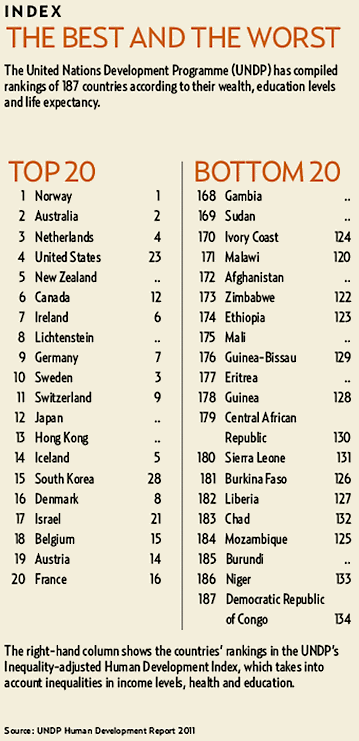

The United Nations Development Programme (UNDP) report notes that "income distribution has worsened in most of the world, with Latin America remaining the most unequal region in terms of income, even though several countries including Brazil and Chile are narrowing internal income gaps. Yet in overall IHDI terms, including life expectancy and schooling, Latin America is more equitable than sub-Saharan Africa or South Asia".
Countries like USA, New Zealand, Canada, Ireland, Liechtenstein, Germany and Sweden round out the top ten countries in the 2011 HDI "but when the index is adjusted for internal inequalities in health, education and income, some of the wealthiest nations drop out of the HDI's top 20 - the US falls from No 4 to No 23, the Republic of Korea from No 15 to No 32, and Israel from No 17 to No 25", says UNDP report. Other top national achievers rise in the IHDI due to greater relative internal equalities in health, education and income: Sweden jumps up from No 10 to No 5, Denmark climbs from No 16 to No 12, and Slovenia rises from No 21 to No 14.
This report shows trends but it is important to underline the main conclusion: equality is the key for a better future for all. And that's why the global effort to support developing countries makes sense. The report emphasizes global action is urgently required for sustainable development, but local initiatives to support poor communities can be both highly cost-effective and environmentally beneficial and several examples are given. The challenge is still the same: make globalization work for both developed and developing countries, because there is no doubt all must benefit from globalization. The big question is about to make things work for all.
This report shows trends but it is important to underline the main conclusion: equality is the key for a better future for all. And that's why the global effort to support developing countries makes sense. The report emphasizes global action is urgently required for sustainable development, but local initiatives to support poor communities can be both highly cost-effective and environmentally beneficial and several examples are given. The challenge is still the same: make globalization work for both developed and developing countries, because there is no doubt all must benefit from globalization. The big question is about to make things work for all.
read more: 2011 Human Development Report

No comments:
Post a Comment